
USS North Carolina BB-55
USS North Carolina (BB-55) was the lead ship of the first new-construction American battleship class completed after the interwar treaty limits lapsed, and the fastest battleship afloat when she was commissioned in 1941. She earned fifteen battle stars in the Pacific before returning home to become a museum ship at Wilmington, North Carolina, where her powder magazine remains open to visitors. The magazine stores the silk bags of smokeless propellant powder used to fire her 16-inch/45-caliber main battery guns — housed deep in the hull below the armored deck for maximum protection, with a system of conveyors and scuttles that move the powder bags from storage to the powder flats and elevators leading up to the turrets. The photos below show the magazine as preserved today.
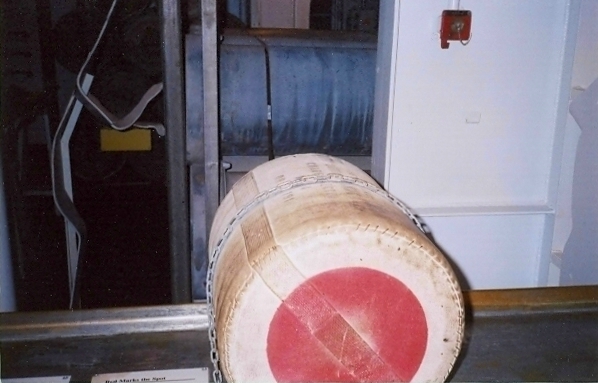
These pictures are from inside the powder magazine on board the USS North Carolina. This picture shows one powder bag on a floor mounted conveyor. The chain is to keep visitors from messing with the powder bag. Note the Red Ignition pad which must be positioned correctly in the gun in order for the gun to fire.
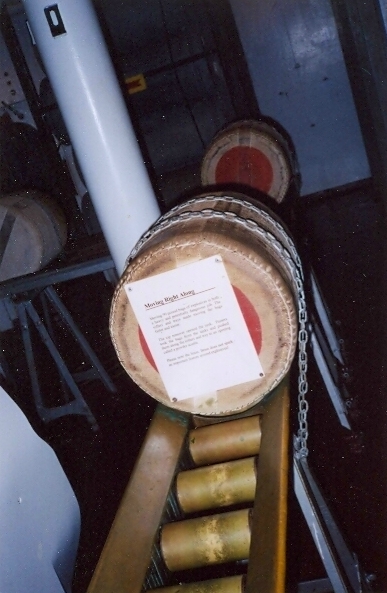
Here you can see two powder bags mounted on the conveyor as well as the chains. Note the Red Ignition pads. Six bags are placed on the conveyor by the powder handlers in the magazine and then they are rolled along the conveyor to the powder scuttles which transfer one powder bag at a time from the powder magazine into the powder flat, where the powder handlers load the powder charges one charge at a time into the powder elevator which carries six powder bags at one time up to the gun house.
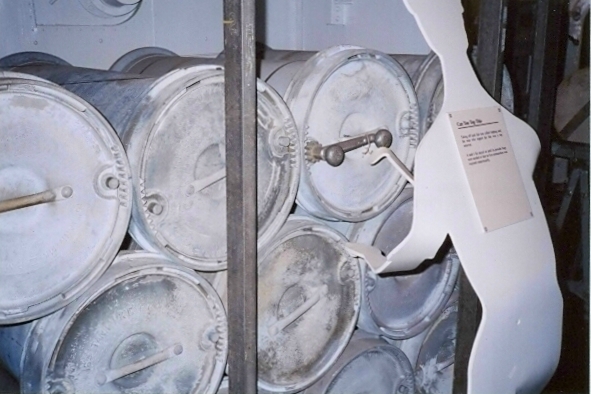
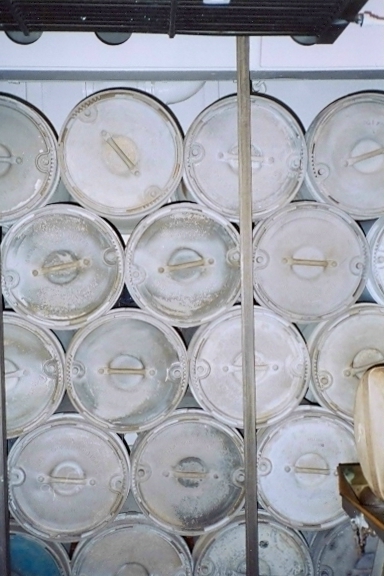
The cardboard man cutout is shown with a wrench opening a powder canister. These powder canisters are locked together by the locking rings on each end of the canisters and stacked on top of each other — no rack of any kind is needed. The vertical bar you see in the center of the picture is to prevent visitors from hurting themselves if they somehow manage to turn the canisters over.
Ether, Alcohol, and Magazine Ventilation
Ether and Alcohol.—A mixture of ethyl ether and ethyl alcohol is used as a solvent for the nitrocellulose. They are required to be of a high purity.
In the powder room when continuous firing for several hours, the ether and alcohol vapors released when opening the powder canisters can give the powder handlers quite a high — makes them a little drunk.
1437. Cooling and ventilating.—The property of imparting on firing, after a length of time in storage, the velocity and pressure found on acceptance test is called the “ballistic stability” of a propellent powder. In order that this property be not impaired, special lagging and ventilation equipment are installed in magazines to provide storage conditions as uniform and favorable as possible.
It has been found that a temperature of 70° to 80° F. is suitable for the storage of standard Navy smokeless powder, while its life is rapidly shortened by temperatures over 90° F. To provide a uniform cool atmosphere in the magazines, various systems of refrigeration have, in the past, been tried with varying success. However, at the present time, due to increased stability of our powders, and to improved methods of ventilation, and because of the difficulties in refrigeration systems, refrigeration is no longer resorted to.
The following considerations govern the installation of ventilation systems for magazines:
- Ventilating pipes must be so installed that no magazine can be flooded from another through the ventilating pipes.
- Ventilating pipes, water-tight below the lowest armored deck (third deck).
- Intakes, so located as to minimize the possibility of drawing in gas from fires in action.
- Natural exhausts, fitted to a fixed height above the water line, behind armor.
- Natural exhausts, located inside turret barbettes, where practicable.
- Lower ends of exhausts, fitted with check valves to permit egress of water or air, but not to permit ingress of either.
- Lower ends of supply ducts, fitted with water-tight covers for sealing in action.
- When ducts pass through a deck or bulkhead, construction must be water-tight and fitted with a slip joint and water-tight cover for sealing.
- Intakes, fitted to prevent foreign matter entering.
An exhaust duct is fitted with a non-return flapper valve and leads up through the deck inside a barbette, where practicable, where it ends in a goose-neck covered with wire mesh. When a magazine is fully flooded, the water escapes in the same way, preventing pressure being brought on the bulkheads. The height of the duct is fixed above the water line by the hydrostatic pressure which the compartment is designed to withstand. Magazines are not ventilated in action, so the blowers are stopped and the supply ducts sealed with hinged covers.
Magazines are insulated with cork composition in order to reduce changes in temperature to the minimum. When the outside temperature is above 90° F. in the daytime, magazines may be kept cool by running the blowers only at night, when the magazines may be filled with air at the minimum temperature.